

Interview with Ranko Radovanović, leader of the Air Traffic Controllers Union, on the mobilization in Serbia
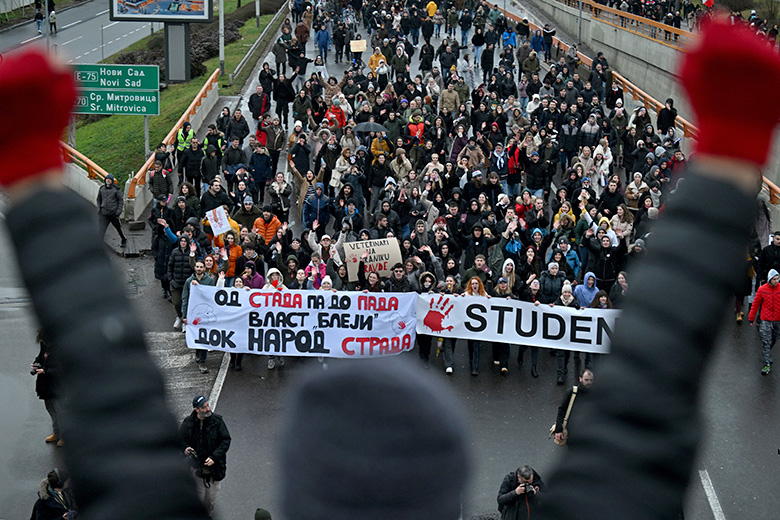
The repressive and neoliberal regime of Serbian President Vučić, leader of the Serbian Progressive Party (SNS) which has been in power in Serbia since 2012, has been shaken since November 1, 2024.
The railways, which had been operating smoothly since the 1960s, entered a process of “modernization” under Vučić’s rule. The most serious consequence of this neoliberal transformation of the railways into high-speed trains was the accident that occurred at the Novi Sad train station on November 1, 2024. Following this tragic event, which claimed the lives of 14 people, including a child, the mobilization that began in Novi Sad spread throughout the country and, over the course of more than a year, has continued to grow stronger, led by young people, rather than fading away.
The ongoing mobilization in Serbia against the regime’s neoliberal policies and repressive practices is significant in several respects. Firstly, unlike previous mobilizations in Eastern Europe, this one did not become an example that could be poisoned by the European Union’s democratic reactionary policies. The European Union stood by Vučić, an open supporter of Putin. The European press did not show sufficient interest in these mobilizations for a long time. As a result, Brussels offered Vučić political support. All of this went hand in hand with the European Union’s policies of keeping migrants outside its borders and preventing Chinese investments from entering Europe. The mobilization of the Serbian people indicates that the EU is not a solution to anti-democratic practices but rather one of the problems.
The example of Serbia, on the other hand, is one that shatters the illusion of a resistance axis of China-Russia against the US-EU powers. The latest example of this is: Vučić, Putin’s strongest supporter, passed a legislative amendment allowing Trump’s son-in-law to lease the land of the former Yugoslav General Staff Headquarters in Belgrade to build a hotel and open it to tourism. The land was damaged by NATO bombing in 1999 and had been preserved as a cultural heritage site for 99 years to reveal NATO’s true face. This law was also protested by thousands of people on November 11.
In addition to the power of mobilization, the Vučić administration continues to show off its strength and strive to stay afloat with the support of the US, the EU and Russia. In addition to the tents set up in front of the parliament by Vučić’s supporters, a military parade was held in Belgrade on September 20 to intimidate the masses, involving approximately 10,000 military personnel, 2,500 weapons and military equipment, and both land and air forces.
While all this was happening, class struggle in Serbia also emerged as part of the mobilization. We share with you the interview with Ranko Radovanović, leader of the Sindikat Kontrole Letenja (SKL-Air Traffic Controllers Union).
I met Ranko at the executive committee meeting of the European Transport Workers’ Federation in May. In Serbia, the working-class organizations had begun to join the mobilization, initially led by young people, and Ranko’s union was one of those targeted even in May. Without playing up to the Western unions, Ranko and another SKL leader, who took a clear trade unionist stance on issues such as the independence of unions from governments and the removal of rights to organize, were dismissed from their jobs in the recent period.
As our international IWU-FI and Workers’ Democracy Party (IDP), we always stand with the masses mobilizing against repressive regimes and capitalism, and with independent unions and their leaders. In the coming period, we aim to cover the mobilization in Serbia more extensively in Gazete Nisan.
We also call on our readers to support the petition campaign launched against anti-union practices in Serbia. To support:
https://www.labourstartcampaigns.net/show_campaign.cgi?c=5744
Interview by Sedat Durel
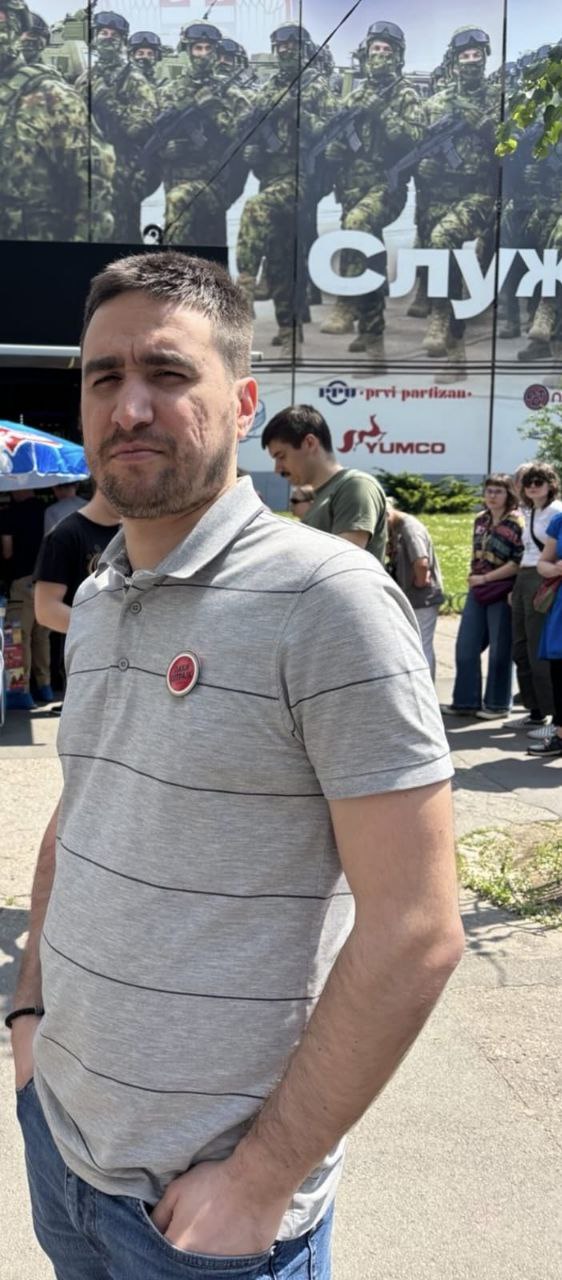
Hello Ranko, first of all, thank you very much for agreeing to this interview. Before we begin, two executives of Sindikat Kontrole Letenja, including yourself, were dismissed on fabricated grounds. In response, ETF and ETUC launched an international campaign. Could you tell us about this union-busting attack in Serbia and how the campaign has been received, both nationally and internationally?
The Serbian ruling party is treating independent, strong unions in Serbia like they are their political enemies. They expect full political obedience from all unions in the public sector, our dismissal is a way for them to show political strength; by scapegoating independent union leaders they show others what’s to become if they are not in line with the ruling party’s political interests.
The international campaign launched by ETF and ETUC has been received very well in union and activist circles but has so far failed to gain traction outside of our niche. This is largely due to public disinterest in union and social matters. Unionism is facing a steep climb in almost every regard, so raising our issues in times like this is extremely hard. Unions are regarded as somewhat risky and unpredictable by almost all major players and interests, including the media conglomerates.
We are witnessing one of the largest mass mobilizations in Serbia’s recent history. It appears that everything began after the tragic train accident that took place in Novi Sad on 1 November 2024. This accident revealed that public resources in Serbia are not being used for workers or the people. The mobilization has continued for a full year under different banners. In this period of a deep political crisis, what has changed, and what has remained the same?
In Serbia everything has changed. There is basically no part of society that hasn’t been affected by what the student movement represents and stands for. It is a period of both social and political crisis. People of Serbia do not want authoritarianism which is increasingly showing incompetence and complete disregard for the needs of common people, crumbling under institutional, deep-seeded corruption.
The strongest component of the mobilization seems to be the youth. Could you tell us about the situation at the faculties and the demands of the youth? And have any young people reached out to your union to express solidarity or offer support?
Yes, the new generation or generation Z as they call it, has changed the game in Serbia. Their main characteristic is to question everything around them, and by everything I really mean everything. The tragedy that happened in Novi Sad triggered them to question the level of corruption in our society and how it endangers all of us. It sparked protests which were then countered by physical attacks from ruling party phalanges, this in turn triggered students to go into mass blockades of universities.
Generation Z is also a part of our union and is the driving force behind our industrial action and strike this summer.
In Turkey, we have been going through a very similar process for quite a long time. A similar tragic train accident took place in Çorlu in 2018. Beyond the pressure and repression targeting workers’ right to organize, we are experiencing a broad wave of pressure and mobilization that extends even to the municipalities. But unlike Serbia, trade unions in Turkey are not part of these mobilizations — in fact, many avoid them. In your view, is there a connection between the struggle workers are currently waging for their most fundamental rights, such as collective bargaining and fair wages, and the mass mobilizations that have been ongoing for a year?
I think what connects our two societies is authoritarianism and high levels of corruption which is seeded deep into our institutions and society. This is a fertile ground for right wing mobilization and policies which in turn always ends in the repression of independent unions and activists. This is what we are facing, and we need to endure if we truly want to be an advocate for real change.
On the other hand, in times like these unions need to show a level of flexibility, but never when it comes to basic freedoms, that’s what should never be compromised.
Could you also talk a bit about the state of trade unions in Serbia and about your own union? How well organized are unions in Serbia, and how would you assess their independence from the government and employers?
Unions in Serbia are under real pressure and are easily swayed. There aren’t many that can keep their independence for long periods of time. The ruling party knows that unions have limited resources and that it can always outlast them when it comes to pressure and political games. That’s what they will try to do in our case as well.
Finally, we are already making an effort to ensure that the campaign is heard both nationally and internationally. Apart from this, is there anything you would like to ask from our readers or from those who become aware of your campaign?
I would like to ask your readers to spread the word of unionism and its importance not just for workers’ rights but more broadly for the rule of law and freedom of speech and association, especially to those who show disinterest in the matter considering unionism as a thing of the past. If it wasn’t for the unions people would not have most of the rights they have now, like a 40-hour work week for example, most people today are not aware of that, the system hides the importance of unions very well, it’s up to us to spread it.
Also, union leaders cannot be punished politically for protecting the rights of people they represent. The status of union leaders needs to be considered as one of the main parameters for the level of freedom and democracy in a society.
Yorumlar kapalıdır.